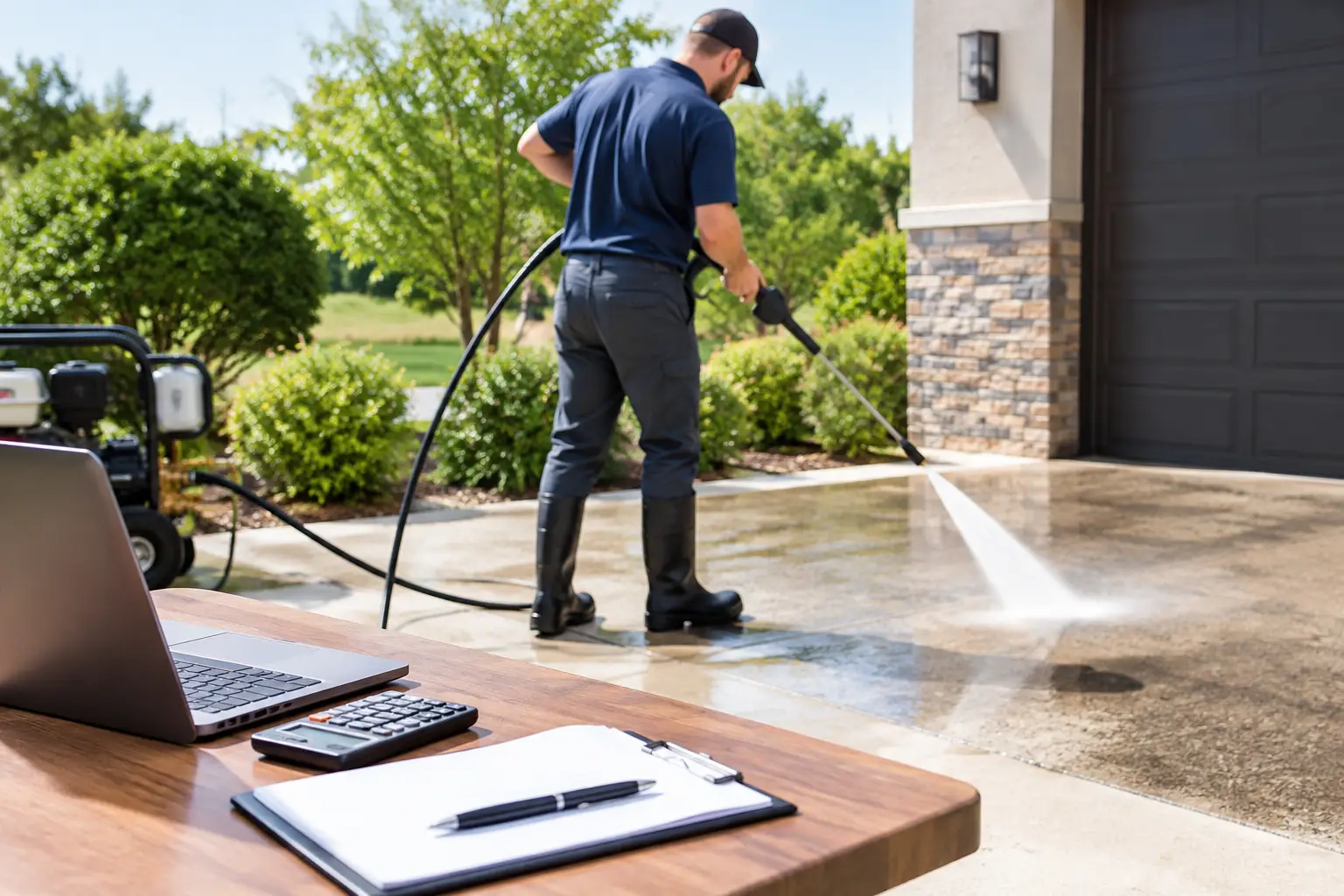
A customer sends photos of a driveway and asks, “How much?” The wrong move is to throw out the number that feels competitive. The better move is to know how to price pressure washing based on the labor, risk, overhead, and profit required to run a real business.
A low quote can win a job and still cost you money. A high quote without a clear scope can lose work you were qualified to complete. Consistent pricing gives you control over both outcomes. It helps you sell with confidence, schedule profitable work, and understand which services are actually moving your company forward.
Start With Your Minimum Profitable Hourly Rate
Before pricing driveways, homes, decks, or commercial properties, determine what one productive hour of your business must earn. This is not simply what you want to pay yourself. It must cover the full cost of operating and leave room for profit.
Start by adding up your monthly business costs: vehicle payments and fuel, insurance, equipment maintenance, chemicals, marketing, software, phone service, merchant fees, payroll, and any subcontractor or disposal costs. Include an owner paycheck if you depend on the business for personal income. Then add the profit you want the company to retain.
Divide that monthly total by your realistic billable hours. Be honest here. A 40-hour workweek does not equal 40 billable hours. Time spent driving, quoting, maintaining equipment, responding to leads, invoicing, and handling weather delays is still part of the business.
For example, if your company needs $12,000 per month to cover operating costs, owner pay, and planned profit, and you expect 100 billable hours, your minimum target is $120 per billable hour. That is a starting point, not necessarily the final number a customer sees. Jobs with more risk, setup time, travel, or specialized chemistry should produce more than the minimum.
Build Pricing Around Production, Not Guesswork
Square-foot pricing is useful, but it only works when it is connected to production speed. You need to know how much area your crew can clean in an hour under normal conditions.
A flat, lightly soiled concrete driveway may move quickly. A heavily stained driveway with oil treatment, gum, poor water access, or extensive edging will not. The same applies to house washing. A single-story vinyl home with easy access is different from a two-story property with steep terrain, fragile landscaping, or oxidation concerns.
Track how long completed jobs actually take, including setup, treatment, cleanup, customer communication, and loading out. After 10 to 20 jobs, you will have better data than any generic online price chart can provide.
Use a simple calculation:
Estimated labor hours x target hourly revenue + direct job costs = base quote
Direct job costs include chemicals, special treatment products, rental equipment, dump fees, tolls, and wages for additional labor. If a driveway should take two hours at a $120 target rate and requires $20 in materials, the base quote is $260. If the work requires difficult stain removal or is located well outside your service area, adjust upward for the added time and risk.
How to Price Pressure Washing by Service Type
Your pricing method should match the service. One fixed formula across every job creates problems because production rates and liability change by surface and property type.
Driveways, sidewalks, and concrete
Concrete work is often priced by square foot, with a minimum service charge. The minimum matters because a small walkway still requires travel, setup, equipment wear, customer communication, and payment processing. A $75 job may take nearly as much administrative effort as a $300 job.
Measure the area when possible, then account for condition. Light organic growth is not the same as embedded oil, rust, paint, or chewing gum. Standard cleaning can have a standard rate. Specialty stain removal should be an add-on with its own price and expectations.
House washing
House washing is commonly quoted by square foot, linear foot, or a price range based on home size and complexity. Do not price only from the home’s listed square footage. That figure describes interior living space, not necessarily the exterior surface you will clean.
Look at stories, siding material, access, landscaping, oxidation, screened areas, detached structures, and water supply. A clear scope protects both sides: identify the surfaces included, the cleaning method, and exclusions such as pre-existing oxidation, failing paint, or damaged screens.
Roof cleaning
Roof cleaning carries more risk and should be priced accordingly. Material type, pitch, access, landscaping protection, runoff management, and the severity of organic growth all affect labor and liability. Do not use a low house-wash rate simply because the roof is near the house.
A detailed inspection is especially valuable here. If the roof requires extensive plant protection, multiple applications, or controlled runoff, build those steps into the quote. Rushed roof pricing can create expensive callbacks and damage claims.
Commercial work
Commercial properties can produce repeat revenue, but they also introduce scheduling requirements, larger insurance expectations, after-hours labor, traffic control, water recovery, and longer payment cycles. Price the operational burden, not just the visible square footage.
A commercial quote should define frequency, service areas, access responsibilities, water availability, working hours, and what happens when vehicles or tenant activity prevent completion. A recurring contract may justify a lower per-visit rate if it improves route density and keeps crews productive. It should not force you below a sustainable margin.
Set Minimums, Add-Ons, and Travel Rules
Minimum pricing prevents small jobs from consuming your day without producing enough revenue. Your minimum should cover the time required to take the lead, travel, set up, complete the work, collect payment, and close out the project.
Add-ons protect your margin when a job falls outside the standard scope. Common examples include heavy stain treatment, rust removal, screen enclosure cleaning, second-story access, patio furniture moving, pool deck cleaning, and unusually long hose runs. These are not surprise charges when discussed upfront. They are the cost of additional work.
Travel deserves the same discipline. You can include normal travel inside your core service area and charge a travel fee outside it, or set higher minimums for distant jobs. Either approach works if it is consistent. What does not work is accepting scattered, low-dollar jobs that leave your truck full of equipment and your schedule full of windshield time.
Quote the Scope Clearly and Fast
Pricing is only half the sale. Customers also need to understand what they are buying. A professional quote should state the service areas, price, exclusions, scheduling expectations, payment terms, and any conditions that could change the final scope.
Avoid vague descriptions like “pressure wash house.” Instead, describe the work: soft wash exterior siding, clean soffits and fascia, rinse reachable exterior windows, and remove organic growth from designated surfaces. If a stain may not fully lift, say so before the job begins.
Fast follow-up matters as much as clean math. When estimates live in text messages, notes, and memory, leads get missed and scopes become inconsistent. A focused system such as CloseFlow can help you create organized quotes, manage projects, and track the activity tied to booked revenue without building your workflow around scattered tools.
Review Results and Adjust With Real Job Data
Your first pricing system will not be perfect. The goal is not to find one permanent number. The goal is to create a process that improves as your company gains data.
After each job, compare estimated hours with actual hours. Record the final price, direct costs, upsells, and any issue that slowed production. If you consistently finish a service faster than planned, your production rate may be better than expected. If jobs regularly take longer, your quote needs a higher rate, a clearer scope, or better job selection.
Watch your close rate, but do not treat it as the only scorecard. Closing nearly every estimate can mean your pricing is too low. A healthy business wins the right work at a price that supports reliable service, equipment replacement, owner income, and future growth.
The best price is not the lowest number a customer will accept. It is the number that lets you deliver quality work, protect your schedule, and build a company that is still profitable after the truck is parked.